Short answer: Quebec's health network has begun phasing out the fax machine — Radio-Canada (Radio-Canada, the French-language public broadcaster) reported on it in the spring of 2026 — but for a sender located in France, Belgium or anywhere else in Europe, the fax often remains the only open channel to a Quebec facility. The portals replacing it (Dossier Santé Québec (Quebec Health Record), the health booklet, the internal messaging systems of the health and social services network, secure email between professionals) are reserved for registered users and care providers accredited in Quebec: a French doctor, a relative in Europe or a foreign insurer simply has no account. The practical consequence: you keep dialling 011 33 in reverse — in other words 00 1 plus the ten Canadian digits from France — you take care with the cover page (patient's name, RAMQ (Quebec Health Insurance Board) card number, name of the department, not just "medical records" in general), and you prepare a backup channel — international registered mail, hand delivery by a relative on site, or professional-to-professional transmission — because a disconnected fax number never warns its foreign correspondents.
About MondialFax. This article is an informational guide, with no connection to any telecom operator, government body, healthcare facility or official directory. MondialFax sends faxes free of charge and without registration to seven destinations (France, Belgium, Germany, Spain, Italy, Portugal, Canada) from a browser, with a daily sending limit. It does not assign a number and does not provide reception. See the supported countries page and the dialling code directory.
What is actually happening inside the Quebec network
The ministère de la Santé et des Services sociaux (Ministry of Health and Social Services) and Santé Québec (Santé Québec, the provincial health agency) have been pushing for several years towards structured digital exchanges: electronic lab requisitions, prescriptions transmitted through the Dossier Santé Québec (Quebec Health Record), online appointment booking, and internal messaging between facilities belonging to the same CISSS (Integrated Health and Social Services Centre) or CIUSSS (Integrated University Health and Social Services Centre). The administrative merger of facilities under Santé Québec (Santé Québec) has accelerated the shift: a fleet of fax machines scattered across hundreds of sites is expensive, hard to manage and poorly suited to confidentiality audits.
But "phasing out the fax" does not mean "fax lines cut everywhere tomorrow morning". Three realities coexist in 2026:
- Departments already fax-free, where an incoming fax lands in a shared fax-to-email inbox, sometimes checked only once a day.
- Departments still heavily dependent on the fax: medical records, admissions, outpatient clinics, hospital pharmacies, insurer billing services.
- "Ghost" numbers, printed on PDF forms that are several years old and still online, even though the line no longer exists.
It is that third category which traps the foreign sender: no warning at all, and sometimes even a positive transmission report if the number has been reassigned to another device.
Why a European sender cannot use the replacement
From the Quebec side, the argument is sound: why fax when you can upload a document to Carnet santé Québec (Quebec Health Booklet), send it through an interoperable messaging system between professionals, or submit it via a private insurer's portal? Except that all of these channels assume a local digital identity:
| Quebec channel | Who can use it | A sender in Europe? |
|---|---|---|
| Dossier Santé Québec (Quebec Health Record) / clinical messaging | professionals authorised in Quebec | no |
| Carnet santé Québec (Quebec Health Booklet) | user with Quebec authentication | only if the person is registered themselves |
| Private insurer's portal | policyholder or their representative | sometimes, with an account |
| Ordinary departmental email | varies, often refused for health data | rarely accepted |
| Fax | anyone, no account needed | yes |
This is exactly the same asymmetry described for Europe in our overview of the digitalisation of public administrations: the modern channel is reserved for residents, and the channel "open to everyone" remains the old one. A GP in Lyon who needs to send the discharge summary of a patient who has returned to France will have neither a Quebec certificate nor access to clinical messaging. The fax is all that is left — or postal mail with a two-week delay.
The most common cross-border cases
In practice, the documents crossing the Atlantic by fax almost always involve one of these five scenarios.
1. A relative hospitalised in Quebec, the family in Europe
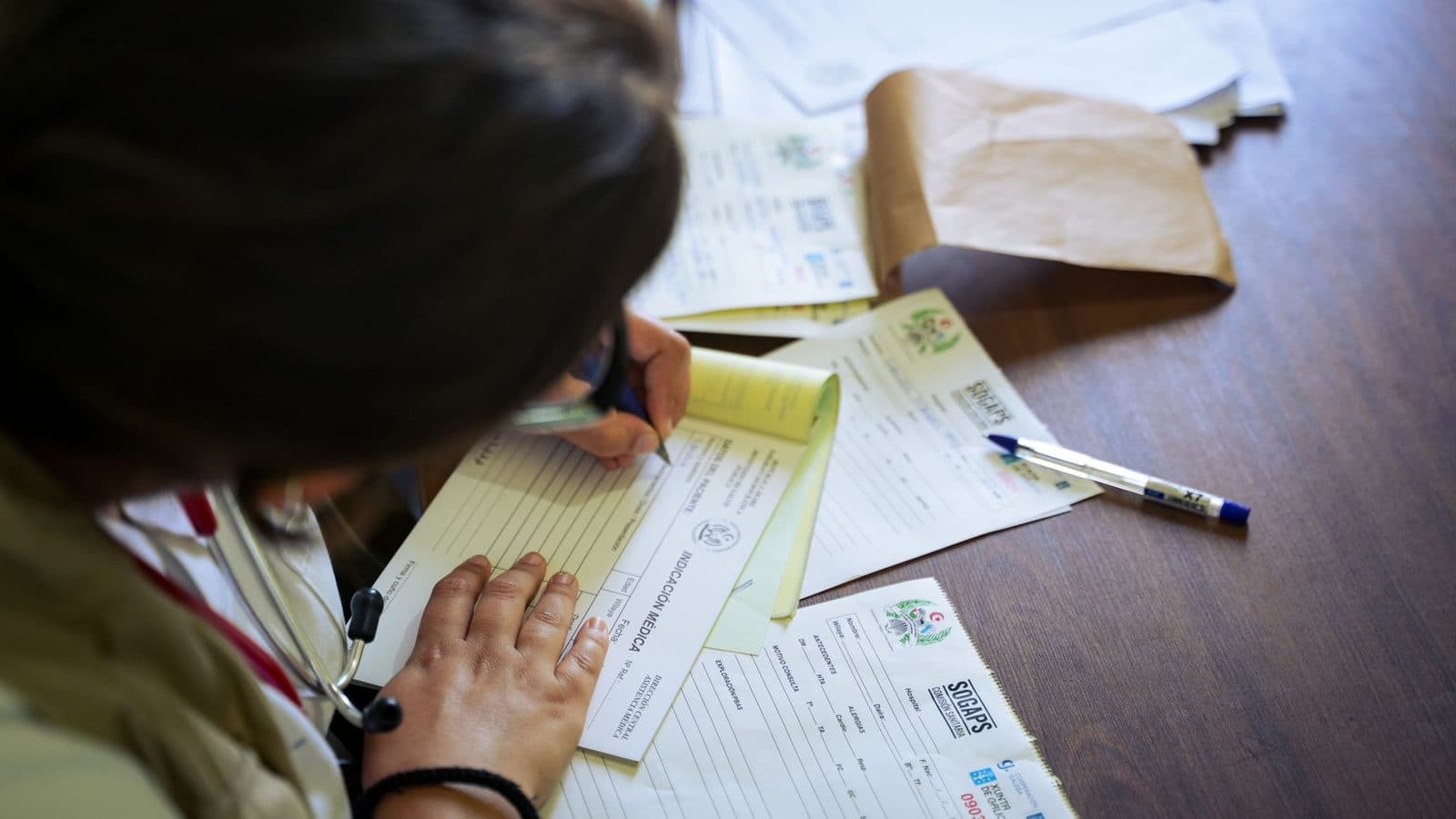
Protection mandate, advance medical directives, written authorisation, power of attorney to obtain information: these documents have to arrive quickly, signed, and the facility wants a record. The fax still does this job very well, provided you write the name of the receiving department and the file number on the cover page. To sign and send documents back cleanly from home, a portable sheet-fed document scanner produces a far more legible result than a cropped phone photo.
2. Returning to Europe after care in Canada
The patient goes home and their European doctor asks for the reports. Quebec medical records departments generally require an access authorisation form signed by the patient — and it is that form, not the file itself, that goes by fax. The file then comes back by secure email, by post, or by fax in turn.
3. A travel insurance claim
Insurers and assistance companies still work extensively by fax with Canadian facilities. We covered this on the claims side in the article on health emergencies abroad: proof of sending within the deadline often counts as much as the content.
4. A prescription or a refill
Canadian pharmacies widely accept faxes from one professional to another, but not from a private individual. This point surprises many expatriates and we addressed it in why Canada still faxes.
5. A RAMQ (Quebec Health Insurance Board) reimbursement claim for care received outside Quebec
Here the flow is reversed: invoices and receipts are sent from Europe to a Quebec body. The official form always takes precedence over improvisation; check the current version before sending, because old versions circulate as PDFs for a very long time.
Dialling the number: where everything is won or lost
Canada and the United States share country code 1. A Quebec number is written as (514) 555-0199 or 418 555-0199: a three-digit area code, then seven digits.
| From | What to dial | Example |
|---|---|---|
| France, Belgium, Germany, Spain, Italy, Portugal | 00 1 + 10 digits | 00 1 514 5550199 |
| E.164 format (online services) | +1 + 10 digits, no spaces | +15145550199 |
| Within Canada | 1 + 10 digits | 1 514 555 0199 |
Three mistakes keep coming up:
- Keeping the brackets and the hyphen in an online form field: many services accept digits only. The issue is covered at length in International fax number: the format that works.
- Mixing up a department's phone number with its fax number: in Quebec they often differ by a single digit. A fax sent to a voice line produces a negotiation failure, not a clear error message.
- Leaving out the area code because a local document omitted it. Quebec's current area codes — 514, 438, 450, 579, 418, 367, 819, 873, 263, 468 — are never optional from abroad.
Quebec's area codes have overlapped geographically since successive overlays were introduced. A 468 and a 418 can serve the same street: never "correct" an area code that looks odd to you.
The time difference decides how your day goes
Quebec runs six hours behind mainland France (five during the two-week desynchronisation around the clock changes in spring and autumn). A medical records department open from 8 a.m. to 4 p.m. Montreal time corresponds to 2 p.m. – 10 p.m. in France.
In concrete terms: a fax sent from Paris at 9 a.m. arrives in an empty room and will sit in the output tray — or in an unchecked email inbox — until the middle of the local afternoon. If the document is confidential, it is better to aim for the 3 p.m. – 6 p.m. slot, French time, so that it is picked up quickly. We have devoted a whole guide to this mechanism: faxing across time zones.
Another deceptive detail: Quebec facilities close for public holidays that are not yours (Fête nationale (Quebec National Holiday) on 24 June, Canada Day on 1 July, Thanksgiving in October, Remembrance Day on 11 November for federal services). A small international wall calendar placed near your workstation saves plenty of transmissions into the void when you handle this type of correspondence regularly.
What to do when the fax machine no longer answers
This is the scenario that will keep multiplying as the Quebec network unplugs its machines. Here is the sequence that works.
- Read the failure report. "Invalid number" points to a dead or badly formatted number; "no answer" points to a line that rings without a fax machine; "negotiation failure" points to a faulty device or VoIP gateway at the other end.
- Call the number by voice. A fax tone confirms the machine exists. A greeting message, a voicemail box or silence tells you the opposite within ten seconds.
- Call the facility's switchboard and ask for the fax number of the specific department, not the facility's general one. In Quebec, each outpatient clinic often has its own.
- Ask for the replacement channel in writing. Many departments now have a dedicated secure email address for external requests, which they do not publish on their website.
- Document the attempt. Keep the transmission report, timestamp and cover page: that is your proof of diligence if a deadline is at stake. The full method is in International fax down: the plan B in 2026.
For bulky or recurring cases, an expanding file folder with dividers lets you keep the sent copy, the transmission report and the reply received side by side — far more robust than a digital folder scattered between an inbox and an online service.
Preparing a document that goes through first time
The quality of a transatlantic fax is decided before sending, not during.
- One document per transmission. Two separate requests in the same fax will end up with only one of the two departments.
- Strong black and white, 200 × 200 dpi minimum. Yellow highlighters and faint stamps disappear completely; a fine-tip black marker stays legible after faxing.
- No staples or sticky notes on the original you are scanning.
- An explicit cover page: the patient's name exactly as the facility records it, date of birth, RAMQ (Quebec Health Insurance Board) card or file number, the exact name of the department, the number of pages, and a number where you can be called back, with its international dialling code. Our cover page generator does the job.
- A genuine handwritten signature, scanned. Canadian facilities often refuse a signature pasted in as a low-quality image.
- A confidentiality notice on the first page, in French and English: bilingual Quebec departments appreciate it, and it is plain common sense for health data.
If you scan a lot at home, an all-in-one printer with an automatic document feeder turns a forty-page file into a single clean PDF, which neither a phone nor a flatbed scanner can reasonably do.
And the other way round: from Quebec to Europe
A Quebec facility that needs to reach a French hospital, a Belgian doctor or a German health insurance fund runs into the mirror-image difficulty: neither Italy's PEC, nor Germany's beA, nor Belgium's eBox is available to it. Many departments therefore keep faxing to Europe, dialling 011 + country code + the national number without its leading zero — 011 33 1 … for Paris, 011 32 2 … for Brussels, but 011 39 06 … for Rome, which keeps its zero. The country-by-country detail is in The end of copper outside France: your faxes country by country.
Frequently asked questions
Have Quebec hospitals really stopped using the fax?
No, not across the board. The network has announced a gradual phase-out and several facilities have already unplugged their machines in favour of internal messaging and the Dossier Santé Québec (Quebec Health Record). But in 2026, many departments — medical records, admissions, outpatient clinics, billing — still receive faxes, often redirected to a shared email inbox.
Can I just send a medical document by email instead?
Technically yes, but many Quebec departments refuse documents containing personal health information received by unencrypted email, under their privacy protection obligations. Always ask whether the department has a dedicated address for external requests before assuming that email will work.
Does a fax have evidential value in Canada?
The transmission report proves transmission, not that the document was read, nor its content. It is useful proof of diligence when facing a deadline, not an acknowledgement of receipt. To strengthen your case, keep the cover page, the timestamped report and a record of the confirmation phone call.
Can a private individual fax a prescription to a Canadian pharmacy?
No, in almost every case. Pharmacies only accept a prescription by fax if it comes directly from the prescriber's office, with their contact details and licence number on the page. A prescription re-faxed by the patient is rejected.
How long should I allow for a reply?
Factor in the time difference, the delay before the fax inbox is checked, and the administrative processing. For a medical records access request, a reply within a few weeks is the norm. Follow up by phone after a week if nothing happens, quoting the date and time of your transmission.
Key takeaways
- Quebec's health network is phasing out the fax department by department, not all at once: check the number before every important transmission.
- The channels replacing it require a Quebec digital identity: a European sender has no access, which keeps the fax as the only open channel.
- From Europe:
00 1+ ten digits, or+1with no space in an online form. From Canada to Europe:011+ country code, without the national zero (except Italy). - Aim for the 3 p.m. – 6 p.m. French time slot to land within Quebec business hours, and watch out for local public holidays.
- A precise cover page (exact department, patient's name, file number) does more for successful delivery than any technical setting.
- Always keep a plan B: a follow-up phone call, a dedicated secure email address, international mail, or hand delivery by a relative on site.
- Keep the transmission report and the cover page: that is your proof of attempt, and it saves deadlines.
For the sending itself, the form on the home page sends to Canada free of charge and without registration, within the stated daily limit; the Canada page summarises the accepted formats.
Sources cited from editorial memory: Radio-Canada (Radio-Canada, report on the end of the fax in Quebec hospitals, May 2026), Santé Québec (Santé Québec), ministère de la Santé et des Services sociaux du Québec (Quebec Ministry of Health and Social Services), Régie de l'assurance maladie du Québec (Quebec Health Insurance Board, RAMQ). Always check the current number and form with the receiving facility before sending anything that matters.
Tagsfaxdestinationspaperless