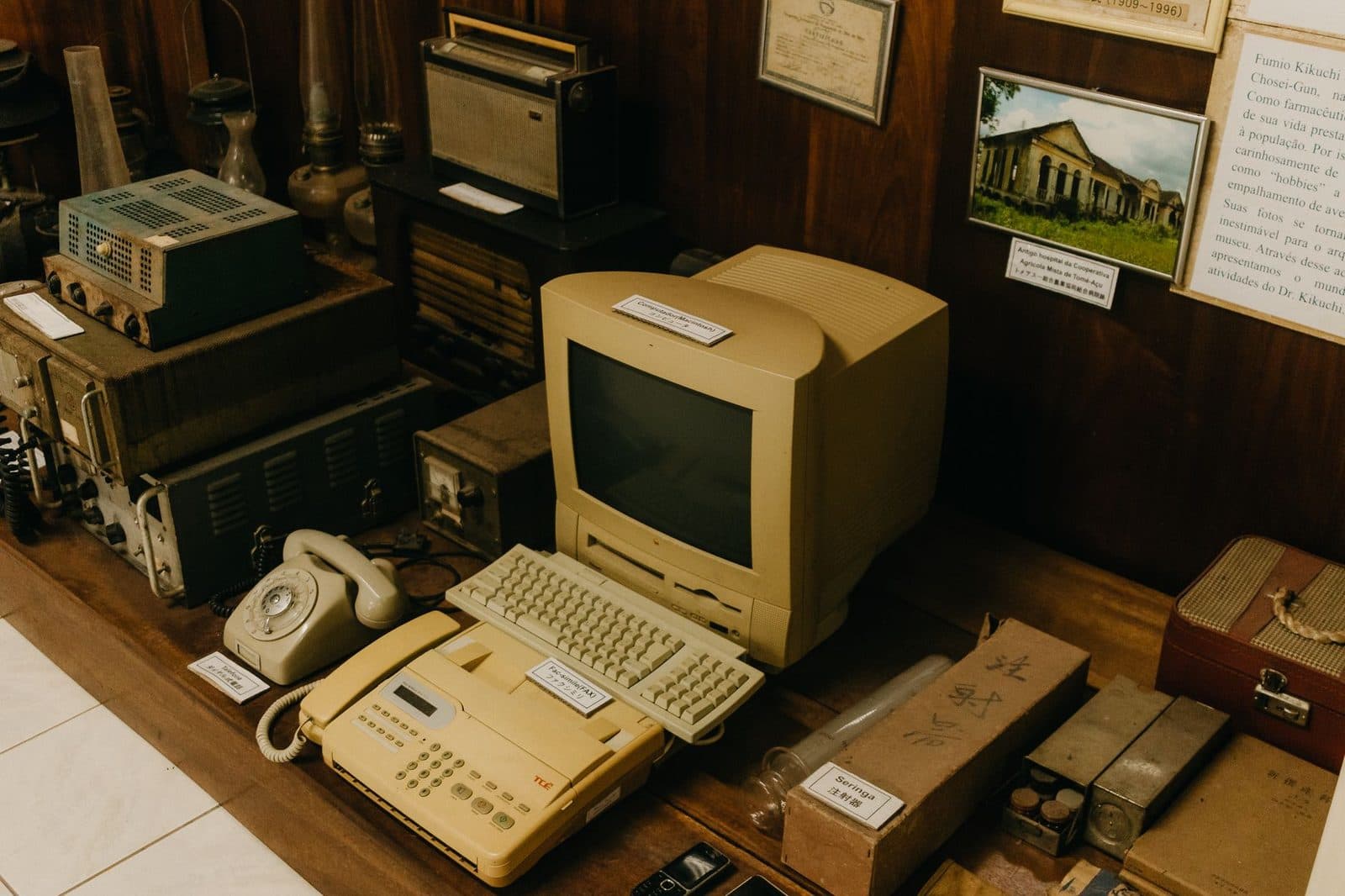
Short answer: tourism is a hyper-digitalised industry in the shop window — booking engines, channel managers, paperless tickets — and surprisingly analogue backstage. As soon as a file leaves the automated circuit (a party of forty, a chartered coach, an outfitting lodge with no connection, an inbound agency that has to prove a payment guarantee, a client cancelling from the airport), the channel that actually gets through is often the fax. In Canada, outfitting lodges (pourvoiries), independent regional hotels, several regional tourism offices, some coach operators and immigration and customs services handling groups still publish fax numbers; in Quebec, people say télécopieur (fax machine) and courriel (email), never "fax" or "mail". In Europe, the trend runs the other way: Spain has moved police registration forms (fiches de police) onto the Interior Ministry's SES.HOSPEDAJES system, Italy onto the Polizia di Stato's Alloggiati Web, Portugal onto SIBA, run by the former SEF now AIMA, Germany onto its digital Meldescheine, and Belgium onto its online municipal declarations. What remains is the margin: an Italian hotelier whose counterpart has no PEC, a German tour operator who wants a signed contract right now, a consulate demanding a legible proof of accommodation. From Europe to Canada, dial 00 1 then the ten digits (418 and 581 for Quebec City and the Gaspé, 819 for the Laurentians and Abitibi, 514, 438, 450 around Montreal, 604 for Vancouver, 902 for the Maritimes); for Germany 00 49, Spain 00 34, Italy 00 39, Portugal 00 351, Belgium 00 32.
About MondialFax. This article is an informational guide, with no connection to any tourist board, hotel chain, outfitting lodge or Canadian or European authority. MondialFax sends faxes free of charge and without registration to seven destinations (France, Belgium, Germany, Spain, Italy, Portugal, Canada) from a browser, with a daily sending limit. It does not assign a number and does not handle incoming faxes. See the supported countries page and the dialling code directory.
Why tourism never fully let go of the fax
Three concrete reasons, and none of them is sentimental.
A signature commits money. An allotment contract, a voucher guaranteeing payment for a group, a bank guarantee letter for a coach deposit: these are signed documents. An email can be disputed, a PDF can be altered, an attachment can vanish into the spam filter of a hotel receiving three hundred messages a day in peak season. A fax, by contrast, produces a time-stamped transmission report at the sender's end and a sheet of paper on the counter at the other. It is not perfect proof — we covered this in detail in fax as evidence in 2026 — but it is a usable record.
Inbound operators work offline. An outfitting lodge on the Côte-Nord, a mountain refuge in Abruzzo, a guesthouse in the Serra da Estrela: the internet connection there is sometimes satellite-based, shared and unstable, while the phone line holds up. Many remote properties keep an all-in-one printer with fax plugged into a VoIP adapter precisely because everything else goes down.
Deadlines are short and asymmetrical. A group cancels at 11 p.m. in Paris, which is 5 p.m. in Montreal: the Quebec inbound operator is still open, the European agency is not. We devoted a full article to this, faxing across time zones, and tourism is its most brutal illustration: six hours between Paris and Montreal, nine with Vancouver, four and a half with Newfoundland.
Canada and Quebec: where the fax machine really survives
Accommodation and the outdoors
The big chains (Fairmont, Delta, Germain) have shut down their fax lines in favour of group portals. The network of Quebec outfitting lodges (pourvoiries du Québec), however, along with campgrounds affiliated with Camping Québec, regional youth hostels and a share of the independent hotels in Abitibi, Saguenay–Lac-Saint-Jean and the Gaspé still publish a fax number on their contact pages, often for group bookings, hunting and fishing packages and permit applications.
Sépaq (Société des établissements de plein air du Québec, the Quebec outdoor facilities corporation) and several ZECs (controlled harvesting zones) still use the fax for certain authorisations and for forms that require a handwritten signature. The same logic applies at Parks Canada for commercial filming or guided-activity permits in some national parks.
Transport and groups
Quebec and Ontario coach operators work with signed charter contracts, route sheets and amendments sent the same day. Cruise operators on the St. Lawrence and ferry excursion operators keep the fax for last-minute passenger manifests. For groups entering Canada, dealings with IRCC and the Canada Border Services Agency go overwhelmingly through portals, but some regional offices still accept documents by fax; we set out the mechanics in faxing a document to Ottawa.
On the tax and insurance side
A European tour operator invoicing in Canada runs into GST/HST and QST: Revenu Québec and the Canada Revenue Agency still maintain fax numbers for certain supporting documents. And when something goes wrong during a package tour (cancellation, accident, repatriation), the Canadian insurer often asks for a signed report — a topic adjacent to our guide on fax and medical emergencies abroad.
Europe: police registration forms have gone digital
This is the decade's big shift in European hospitality. The traveller register, once sent to the police station by fax or by courier, is now electronic almost everywhere.
| Country | Traveller declaration | Official channel | Fax still used for |
|---|---|---|---|
| Spain | Mandatory, extended data set since Royal Decree 933/2021 | SES.HOSPEDAJES (Interior Ministry) | Supporting documents to a local authority, registro electrónico (electronic registry) unavailable |
| Italy | Mandatory within 24 hours | Alloggiati Web (Polizia di Stato) | Exchanges between agencies with no PEC, group contracts |
| Portugal | Boletim de alojamento (accommodation form) | SIBA (former SEF, now AIMA) | Confirmations to rural properties, turismo de habitação (heritage guesthouse scheme) |
| Germany | Meldeschein (registration form), digitalised by state | State portals, digitaler Meldeschein (digital registration form) | Courts, Gewerbeamt (trade licensing office), tour operator disputes |
| Belgium | Municipal declaration / Brussels Hotels | Online portals, eBox for administrative mail | Municipal files, regional licences |
| France | Individual police registration form for foreign nationals | Digital or paper filing | Outside the scope of this article |
In other words: for the statutory declaration, stop trying the fax in Europe — it is a dead channel and sometimes a non-compliant one. For everything commercial and contractual between professionals, it is still very much alive, particularly with the small Italian, Portuguese and Spanish businesses that have no active PEC or whose certified address goes unchecked. The country-by-country detail is in our guides Italy and PEC and Spain and the electronic registry.
The seven documents still going out by fax
- The group voucher. The inbound operator wants an enforceable document before blocking twenty rooms in high season.
- The signed allotment contract. Until qualified electronic signatures become widespread among small accommodation providers, signing on paper and then transmitting remains the norm.
- The coach charter contract and its amendments, with time windows and driving hours.
- The credit card authorization form, still requested by North American hotels for a booking paid by a third party. Careful: this document contains payment data and falls under the confidentiality requirements discussed in fax confidentiality and the GDPR.
- Proof of accommodation for a visa file or a consular application.
- The damage report at the end of a stay or rental, signed by both parties.
- The passenger manifest amended at the last minute for an excursion, a river cruise or a charter flight.
For the first three, scan quality decides everything: a grey signature on a 100 dpi scan turns into an illegible smudge after transmission. A portable sheet-fed scanner, kept behind the front desk, solves in one go the problem of contracts signed in pen in a hotel lobby. And when the contract comes back annotated by hand, a pad of property letterhead avoids ghostly photocopies of badly framed documents.
Sending without a machine, from a hotel or a sales office
The question comes up every season: should you keep a fax machine at the front desk? In 2026, the answer is almost always no. The copper switch-off is progressing outside France at very different speeds — Germany has completed its IP migration, Spain and Portugal are moving fast, Belgium and Canada are closing exchanges zone by zone — and an analogue device plugged in behind a router runs into the classic T.38 failures. We mapped it out in the copper switch-off outside France.
The approach that works for a tourism business:
- To send, an online service in the browser is enough: upload the signed PDF, dial the full international number, get the report. That is exactly what MondialFax's sending form does, to the seven destinations served.
- To receive, you need an inbound number from a provider, with forwarding to a shared mailbox for the reservations team. The principle is explained in receiving a fax by email.
- To archive, one folder per season and per client file, with the transmission report next to the document: in a dispute over a group no-show, that is the item that settles it.
One practical detail often overlooked in small properties: scanning signed documents rarely happens in a quiet office. An LED task light behind the counter radically improves the legibility of document photos taken on a phone, when there is no scanner within reach.
Dialling it right: codes and timing
A fax number is dialled like a phone number, but a dialling-code mistake produces a silent failure rather than an error message.
| Destination | Prefix from Europe | Format | Common tourist areas |
|---|---|---|---|
| Canada / Quebec | 00 1 | 3 + 7 digits | 418/581 (Quebec City, Charlevoix, Gaspé), 819 (Laurentians, Outaouais), 514/438 (Montreal), 450 (suburban belts), 902 (Maritimes), 604 (Vancouver) |
| Germany | 00 49 | area code without the leading 0 | 30 Berlin, 89 Munich, 40 Hamburg |
| Spain | 00 34 | 9 digits | 91 Madrid, 93 Barcelona, 971 Balearics, 922/928 Canaries |
| Italy | 00 39 | keep the leading 0 | 06 Rome, 02 Milan, 041 Venice |
| Portugal | 00 351 | 9 digits | 21 Lisbon, 22 Porto, 289 Algarve |
| Belgium | 00 32 | area code without the leading 0 | 2 Brussels, 50 Bruges, 4 Liège |
As for timing, aim for the window when a human being is near the machine: 9 a.m. – 11 a.m. local time in Canada corresponds to 3 p.m. – 5 p.m. in Paris, Brussels, Madrid, Rome or Berlin, and 2 p.m. – 4 p.m. in Lisbon. The other way round, a late-afternoon European send arrives in the early Quebec morning, which is ideal: the sheet is waiting for the front-desk manager at opening. Avoid Friday after 3 p.m. Canadian local time and, on the European side, long weekends and the August summer closures of Italian agencies.
For mobile teams — guides, tour escorts, group leaders — everything hinges on a phone and a scanning app. A waterproof smartphone case is no gadget when you are sending a damage report from a ferry dock in November, and a high-capacity power bank prevents a failed send at the worst moment. Our guide sending a fax while working remotely details this minimal kit.
Tourism marketing: bulk faxing is regulated
A reminder that avoids fines. Sending last-minute offers by fax to a list of agencies or hotels is fax marketing, and it is strictly regulated.
- In Canada, the CRTC unsolicited telecommunications rules require the national do-not-call list, sender identification and restricted sending hours.
- In the European Union, the ePrivacy Directive as transposed nationally requires prior consent for individuals, with more flexible regimes for certain existing business relationships — and national interpretations that differ between Germany, Italy and Spain.
A free service with no registration blocks bulk sending by design. The detail is in fax mailing: consent, CRTC and bulk sending.
Frequently asked questions
Can a European hotel still receive the police registration form by fax?
No, and it is no longer a matter of preference. Spain (SES.HOSPEDAJES), Italy (Alloggiati Web) and Portugal (SIBA) require electronic filing within short deadlines. A fax does not count as a declaration and does not discharge the host's obligation.
How do I fax a Quebec outfitting lodge from Belgium?
Dial 00 1, then the three-digit area code and the seven digits of the number — for example 00 1 418 XXX XXXX. Check the number on the property's website: many list phone and fax side by side, often labelled téléc. (fax).
Should an independent hotel keep a physical fax machine?
Rarely. To send, an online service is enough and saves on consumables. To receive, a virtual number forwarded to a reservations mailbox is better: the sheet no longer sits around on the counter, and the history is accessible to the whole team.
Does a voucher sent by fax have contractual value?
It counts as the beginning of proof, not as an enforceable title. Keep the transmission report, the cover page and the original signed document. In a dispute, it is the consistency between all three that matters.
What resolution should I use for a signed contract?
Fine resolution (roughly 200 × 196 dots per inch) in black and white, from a sharp scan. Too light a scan erases blue ballpoint signatures; too dark a scan drowns the stamps. If needed, convert the document to greyscale before conversion.
Key takeaways
- Cross-border tourism keeps fax flows alive for signed documents that commit money: allotments, vouchers, charters, card authorisations.
- In Canada, outfitting lodges, campgrounds, independent regional hotels, coach operators and some government services still publish fax numbers; use the local vocabulary (télécopieur, fax machine; courriel, email).
- In Europe, traveller declarations have moved to mandatory digital filing (SES.HOSPEDAJES, Alloggiati Web, SIBA, Meldescheine, eBox): the fax no longer has a place there.
- Dial
00 1+ ten digits for Canada,00 49,00 34,00 39,00 351,00 32for Europe, and aim for 9 a.m. – 11 a.m. in the recipient's local time. - Fax marketing remains regulated (CRTC in Canada, prior consent in the EU): no bulk sending without a legal basis.
- To send without a machine from a front desk or out in the field, an online service and a good scan are enough; to receive, set up an inbound number forwarded to a shared mailbox.
Tagsfaxdestinationspaperless