Short answer: a French or Quebec SME that exports no longer needs a fax machine, but it almost always has two or three foreign contacts who will accept nothing but a fax: a German after-sales department, a Portuguese freight forwarder, a Belgian credit insurer, a Canadian customs broker. The winning reflex is not to buy hardware: it is to document those recipients in a single record (number in international format, local opening hours, fallback channel, person to notify), then hand the sending over to a workstation rather than a machine. In practice: 00 + 32 / 49 / 34 / 39 / 351 / 1 from France, 011 + 33 from Quebec, the regional zero dropped everywhere except in Italy, a cover sheet in the recipient's language, and archiving of the transmission report together with the relevant order or file. Three hours of tidying up is enough; that is the time you currently spend, every quarter, working out why a document never arrived in Antwerp or Laval.
About MondialFax. This article is an information guide, with no connection to a telecom operator, a government body, a freight forwarder or an official directory. MondialFax sends faxes free of charge and without registration to seven destinations (France, Belgium, Germany, Spain, Italy, Portugal, Canada) from a browser, with a daily sending limit. It does not assign a number and does not handle reception. See the supported countries page and the dialling code directory.
Fax in an exporting SME: a residual but critical flow
In a company of twenty to two hundred people, fax is no longer a channel, it is a documented exception. It survives wherever a foreign contact locked down its procedure fifteen years ago and never reopened it. The cases that come up most often in French and Quebec SMEs:
- the transport order or shipping instruction demanded by an Iberian or Italian freight forwarder that refuses attachments from an unknown sender;
- the warranty or after-sales return form of a German manufacturer, whose portal is only open to contracted resellers;
- the transport damage claim filed with an insurer or an average adjuster, with an enforceable date of receipt;
- the mandate or power of attorney sent to a Canadian customs broker who wants a signature on paper, not a PDF returned by email;
- the order confirmation from a spare-parts distributor whose system was never connected to the internet.
These flows have three things in common: they are few in number (a few dozen a year), urgent when they arrive, and handled by a single person in the company — the export assistant, the logistics manager, sometimes the owner. It is precisely that combination that creates incidents: when that person is on leave, nobody knows where the number is, or whether it still works.
Building the recipient record, country by country
The most profitable tool is not a piece of software but a single shared spreadsheet, in which every contact reachable by fax gets one row. Six columns are enough.
| Column | Expected content |
|---|---|
| Recipient | Company name and the specific department (not "head office") |
| Number | Full international format, + followed by the country code |
| Calling window | Local opening hours, converted to France/Quebec time |
| Fallback channel | PEC (certified electronic mail), beA (lawyers' electronic mailbox), eBox, registro electrónico (electronic register), portal, registered mail |
| Last successful send | Date + reference of the retained report |
| Human contact | Name, email, phone of the person who confirms |
The "last successful send" column is the one everyone forgets and the one that saves the most files: a number that has not been used for eighteen months stands a serious chance of having been disconnected during a fibre migration. More on that below.
The dialling formats to write down once and for all
From France, you dial out with 00, then the country code, then the national number without its leading zero — except in Italy, where the city zero (06 for Rome, 02 for Milan) is kept:
- Belgium:
00 32+ the number without the0(00 32 2 …for Brussels); - Germany:
00 49+ the Vorwahl (area code) without the0(00 49 30 …for Berlin); - Spain:
00 34+ the nine digits, no zero to remove; - Italy:
00 39+ the number with its zero (00 39 02 …); - Portugal:
00 351+ the nine digits; - Canada:
00 1+ the three-digit area code + seven digits (514,438,450,418,819,613…).
From Quebec and Canada, the exit prefix is 011, and France becomes 011 33 + the number without its zero. The details of special cases — premium-rate numbers, short numbers, variable lengths in Germany — are covered in our guide international fax number: the format that works.
One trivial but costly detail: store the number in international + format in your table, not with the exit prefix. A number written 00 49 30 … and copied by a colleague in Montreal will never go through. Written +49 30 …, it is readable from both continents.
The "export sending" workstation: what you actually need
Many SMEs still keep a multifunction printer whose fax function has not been used since the line was migrated. Before buying new hardware, turn the question around: what needs to be digitised, and at what quality? In almost every case, the need is a good scan, not a fax machine.
A document scanner with an automatic feeder placed next to the export desk solves 90% of the problem: it swallows a ten-page signed bundle in thirty seconds, produces a clean PDF, and feeds a fax send just as well as an upload to a customs portal. For signatures and stamps that travel badly — the classic case of a bill of lading stamped in pale ink — a pass at 300 dpi in greyscale gives better results than "photo" mode. Our detailed settings advice is in the article unreadable fax: adjusting scanning, resolution and contrast.
Two accessories make a measurable difference on export documents:
- a customisable rubber stamp with the company name, the EORI number and the words "certified true copy", which saves rewriting the same lines by hand on every document set;
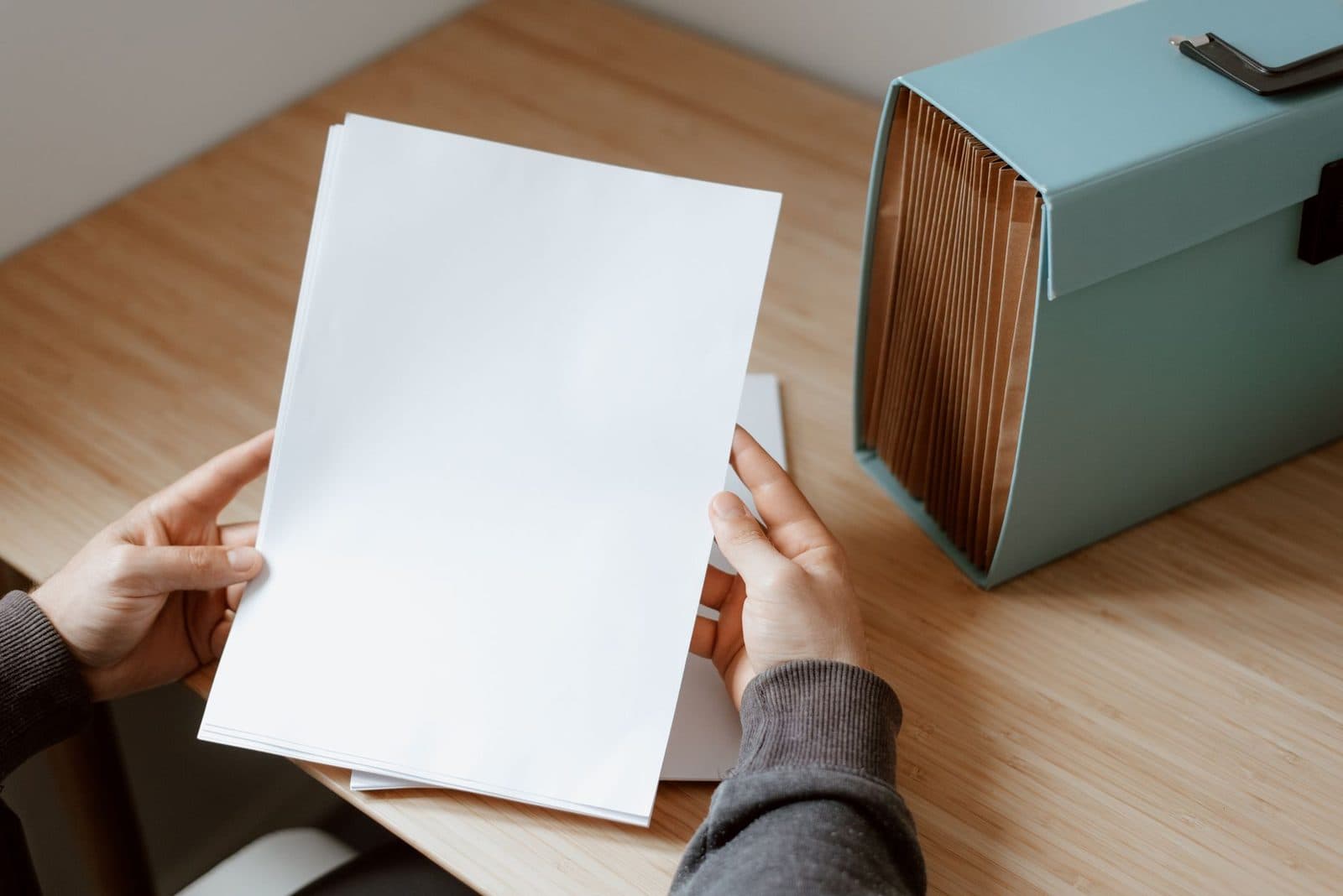
- a stock of expanding folders to hold, for each shipping file, the signed paper set and the printed transmission report — the physical equivalent of the "last successful send" column.
Add a USB telephone headset if the person who faxes is also the one who calls Lisbon or Toronto to confirm receipt: having your hands free while reading a number back on screen prevents half the digit errors.
Hours, time zones and public holidays: half of all failures
A fax always goes out too late or too early. SMEs exporting to Europe and Canada live with the same time difference, in both directions.
- To Canada from France: Montreal is at −6 h in winter, Vancouver at −9 h. A send leaving Paris at 9 a.m. arrives at 3 a.m. in Quebec, on a switched-off machine or with an empty paper tray. Aim for 3 p.m.–6 p.m. French time to land in the Canadian morning.
- To France from Quebec: the reverse. A send at 9 a.m. from Montreal arrives at 3 p.m. in France: perfect. A send at 3 p.m. arrives at 9 p.m.: nobody will process it before the next day, and if the deadline expires at midnight, the proof of sending becomes your only defence.
- Within Europe, the gap is zero or one hour (Portugal at −1 h), but midday breaks are still a reality in some Iberian departments, and shortened summer staffing is the rule in August in Italy as in Spain.
- Public holidays do not coincide: la Fête nationale du Québec (Quebec's National Holiday) on 24 June, la Fête du Canada (Canada Day) on 1 July, the Tag der Deutschen Einheit (German Unity Day) on 3 October, 25 April in Portugal, 2 June in Italy, 21 July in Belgium. A closed freight forwarder will not reissue an acknowledgement.
The details of useful windows are covered in faxing across time zones: Quebec, Europe. A field practice: in the recipient table, record the cut-off time in the sender's local time, not the recipient's. Nobody does the mental conversion at 5.50 p.m. on a Friday.
The fallback channel: knowing what your contact actually uses
An exporting SME does not suffer the copper switch-off in its own country: it suffers it at its customers and providers. When a number stops answering, it is not your line that is at fault, it is the migration of theirs. Hence the value of knowing in advance the dominant digital channel in each country served:
- Belgium: the eBox for exchanges with the federal administration, port-specific platforms for logistics, and identification via itsme for online procedures.
- Germany: the beA (lawyers' electronic mailbox) for the legal sphere, KIM for healthcare, but for an SME the realistic fallback remains a professional email with a read receipt, or even De-Mail at large accounts.
- Italy: PEC (certified electronic mail), now the default channel with evidential value, these days tied to the domicilio digitale (digital domicile) of registered companies — an Italian supplier almost always has a published PEC address.
- Spain: the registro electrónico (electronic register) of government bodies and sector platforms; companies often require a digital certificate to upload a document there.
- Portugal: ePortugal and the customs portals; the CTT for international registered mail.
- Canada: the secure portals of the CRA, Revenu Québec and the CBSA on the government side; on the business side, the platforms specific to customs brokers and carriers.
None of these channels is open to an unregistered foreign sender: that is exactly why fax survives on these corridors. Our country-by-country overview is detailed in copper switch-off outside France: your faxes country by country, and the procedure to follow when nothing gets through at all is in international fax down: plan B.
Proof, traceability and internal control
For an SME, an export fax is only worth anything if it leaves a usable trace six months later, when a transport dispute or a customs audit comes up. The discipline comes down to four points.
- One transmission report per document, kept as a PDF, named with the file reference (
EXP-2026-0412_fax_transitaire.pdf) and not "report (3).pdf". - A cover sheet in the recipient's language: department name, order or bill of lading reference, number of pages, name and direct phone number of the sender. The site's fax cover sheet tool produces a reusable template.
- A human confirmation for any send tied to a deadline: a short email — "4-page fax sent to number X at such a time, file Y, please confirm" — is worth more than a technical report alone.
- Dual storage, digital and paper, for signed documents. One flap archive box per financial year costs the price of a meal and saves pulling out a whole binder in front of an auditor.
On the actual evidential value of a report and its limits, see fax acknowledgement of receipt: proving it arrived.
What is forbidden: unsolicited commercial faxing
A point exporting SMEs underestimate. Sending a commercial offer by fax to a list of foreign prospects is not a grey area:
- in the European Union, the "privacy and electronic communications" directive, transposed in each member state, requires prior consent for fax marketing, including B2B in several countries;
- in Canada, the CRTC's unsolicited telecommunications rules strictly govern marketing faxes, with an exclusion register, mandatory disclosures and permitted time slots.
An individual follow-up on an ongoing file with an existing partner is not prospecting. A simultaneous send to a hundred purchased numbers is. The details are in fax mailing: consent, CRTC and bulk sending.
Frequently asked questions
Does an exporting SME still need an incoming fax number?
Only if partners send you faxes. If your flows are outgoing — shipping instructions, mandates, after-sales forms — a sending service is enough and you have nothing to maintain. If, on the other hand, you receive confirmations or purchase orders by fax, you need a number and reliable reception: the topic is covered in receiving a fax by email. MondialFax, for its part, does not assign a number and does not handle reception.
How do you check that a foreign number is still active?
Call it by voice from a telephone. A modem tone means the machine is answering; a voice, an operator announcement or silence means the number has been reassigned. This ten-second test saves hours of troubleshooting and should become a quarterly reflex for sensitive recipients.
How many pages can you reasonably send?
Beyond ten pages or so, the probability of failure mid-transmission rises sharply on an intercontinental link. For a bulky shipping file, split it into sends of five to eight pages, number them explicitly ("1/3", "2/3") and state the split on each cover sheet.
Is fax safer than email for commercial documents?
Neither more nor less: it is not encrypted and comes out on a shared tray. Its advantage is different — it is accepted where your email will be filtered as spam. For genuinely sensitive documents (bank details, employees' personal data), favour an encrypted channel and compare the options in fax or secure messaging.
Is a fax enough to prove a contractual deadline was met?
It proves a time-stamped attempt to send, which is often decisive in a transport or insurance dispute. It does not prove the document was read. For high-stakes deadlines, always back it up with a named email and, if the contract provides for it, with international registered mail.
Key takeaways
- Export faxing is a residual but critical flow: few sends, high urgency, only one person in the know. Document it before that person is away.
- A six-column recipient record (department, number in
+format, calling window, fallback channel, last successful send, human contact) solves most incidents. - The regional zero disappears everywhere except in Italy;
00from France,011from Quebec. - Timing causes as many failures as technology: aim for the French afternoon for Canada, the Quebec morning for Europe, and watch national holidays.
- Know each country's digital channel (eBox, beA, PEC, registro electrónico, ePortugal, Canadian portals): it is your plan B when a number drops after a fibre migration.
- Keep one report per document, named by file reference, and back up every deadline-related send with a human confirmation.
- No commercial prospecting by fax: prior consent in the EU, CRTC rules in Canada.
Tagsfaxdestinationspaperless