Short answer: Portugal is one of the Southern European countries whose public administration turned its back on paper — and therefore on the fax — the fastest. Between the Portal das Finanças, the Chave Móvel Digital, the ePortugal portal and the Balcão do Empreendedor, neither a professional nor a private individual has any reason left to send a fax to a government service: it does not start any legal deadline, it is not time-stamped and, in many departments, it is not even checked anymore. But the country has not wiped out its fax numbers either. In 2026, three pockets still pick up: healthcare facilities (admissions, hospital pharmacies, testing laboratories), hotels and tourism (properties in the Algarve, Madeira and the Azores, agencies, holiday rentals) and small private operations (law firms, contabilistas certificados, building managers, garages, hauliers). From France, Belgium or Quebec, dialling is simple: 00 351 followed by the nine digits of the Portuguese number, with nothing removed — Portugal has no leading zero.
About MondialFax. This article is an informational guide, unaffiliated with any Portuguese government body or carrier. MondialFax sends faxes free of charge and without registration to seven destinations (France, Belgium, Germany, Spain, Italy, Portugal, Canada) from a browser, with a daily sending limit. It does not assign a number and does not handle incoming faxes. See the Portugal page and the directory of dialling codes.
Why Portugal went paperless faster than you would think
The country has one distinctive feature that explains a great deal: electronic invoicing and certified invoicing software have been mandatory there since long before the European wave. Every Portuguese company issues its invoices through a program approved by the Autoridade Tributária e Aduaneira (AT) and submits its SAF-T (PT) file periodically. In other words, the habit of talking to the tax authority through a structured file rather than a sheet of paper has been embedded for more than ten years.
Three building blocks shape the current landscape:
- Portal das Finanças (portaldasfinancas.gov.pt): tax returns, e-fatura, certificates, exchanges with the AT. Everything goes through a NIF and a password, or through the Chave Móvel Digital.
- Chave Móvel Digital (CMD): the national digital identity, tied to a mobile phone number and a PIN code, now backed up by ID.gov.pt on smartphones. It counts as a qualified signature in many situations.
- ePortugal / Balcão do Empreendedor: the one-stop shop for business and citizen procedures, which absorbed the old paper forms and, with them, the fax numbers that still appeared on official letterheads.
On top of that comes the Sistema de Informação da Organização do Estado, which publishes the official contact details of public bodies: you can see that the "fax" line has gradually disappeared from the records. Where it survives, it is often an unmaintained legacy.
The very concrete consequence for an expatriate or a French small business: never rely on a fax for a Portuguese tax, social security (Segurança Social Direta) or civil registry procedure. The channel sometimes exists, but it produces no legal effect. The same reasoning as in Spain with the registro electrónico, set out in our guide to faxing in Spain in 2026, applies here.
Where a Portuguese fax still picks up in 2026
Healthcare: the last real stronghold
The Serviço Nacional de Saúde has largely digitised prescriptions (receita sem papel, with an access code sent by SMS) and patient records. But between organisations, the peripheral flows hold on:
- Admissions and front-office departments of public and private hospitals: appointment confirmations, forwarding a colleague's referral letter, proof of travel insurance.
- Hospital pharmacies: urgent orders, stock-outs, exceptional authorisations.
- Testing laboratories and imaging centres: sending a prescription to a visiting patient, forwarding a report to a practice abroad.
- Private clinics and continuing-care units, particularly in the autonomous regions, where network coverage long made the fax more reliable than an email attachment.
For a French national living in Porto or a retiree in Tavira, the typical case is requesting medical records from a hospital that accepts a signed form by fax for lack of a working patient portal. A desktop scanner with an automatic document feeder saves a considerable amount of time when the file runs to twenty pages of medical history — far better than holding a phone at arm's length over a table.
Tourism and hospitality
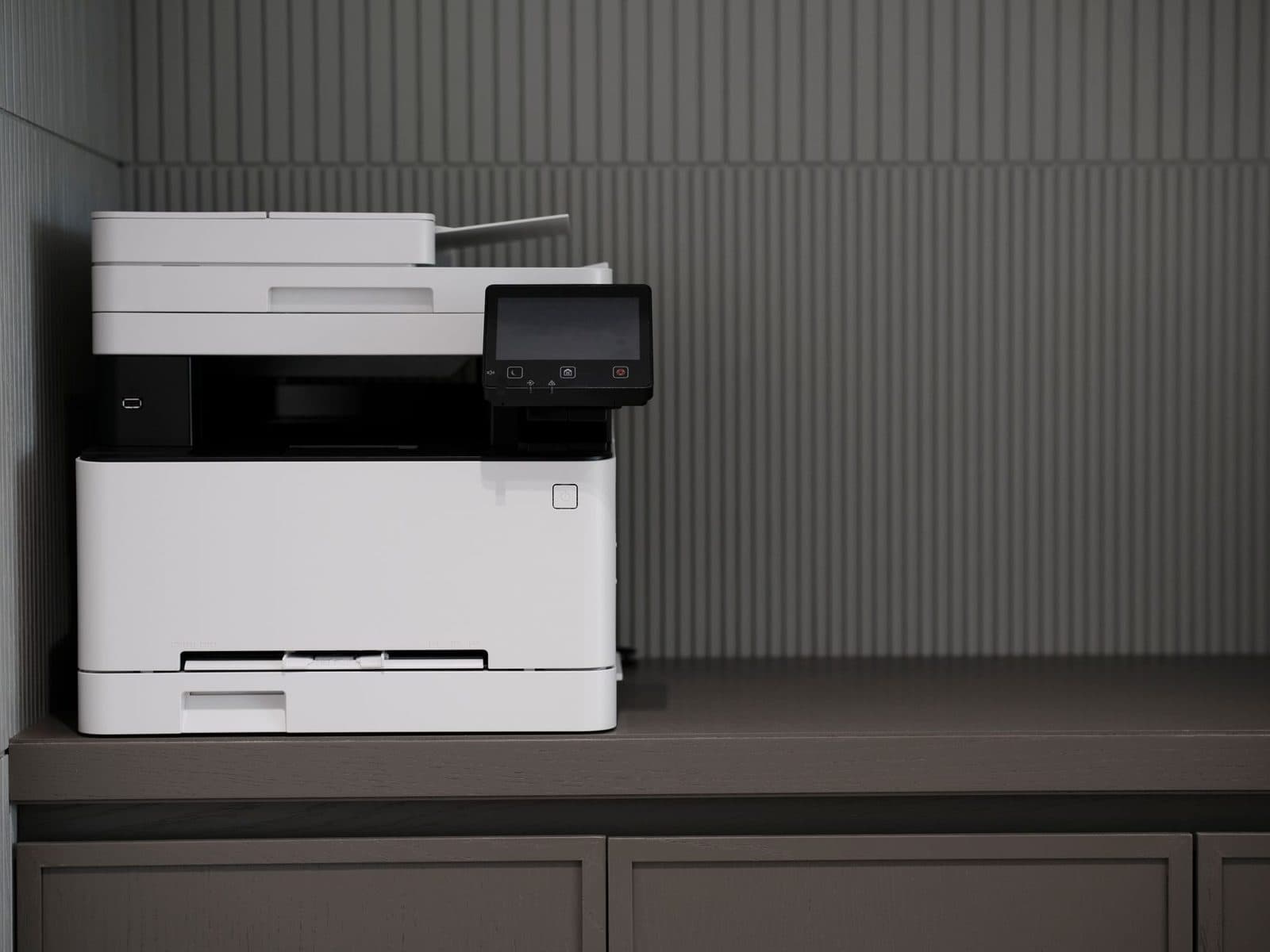
This is Portugal's particularity. The Algarve, Madeira and the Azores have a high density of small properties (residenciais, quintas, rental agencies) that have kept an all-in-one printer behind the front desk. People still send them:
- a signed credit card charge authorisation, for a group or a long stay;
- a travel agency purchase order, with a named guest list;
- a function room or banquet booking request with a countersigned quote.
Large hotel groups, for their part, no longer have a fax: everything goes through their extranet or by email. The rule of thumb holds: the smaller and older the establishment, the more likely the fax number printed on its leaflet still works.
Independent professionals and intermediaries
Advogados and solicitadores use the CITIUS portal for court filings — the functional equivalent of Germany's beA or Italy's PEC. The fax has no place there for proceedings. But between firms, between a firm and a contabilista certificado, between a building manager and a co-owner, it still serves as a fallback channel for a signed document people refuse to send by ordinary email. The same phenomenon exists in Italy, where PEC has absorbed everything on the procedural side: see our analysis of the legal weight of the fax in Italy.
Dialling a Portuguese number from abroad
The Portuguese numbering plan uses nine digits, with no trunk prefix to strip out. So you dial the number in full after the country code.
| From | Full sequence | Example (Lisbon) |
|---|---|---|
| France, Belgium, Germany, Spain, Italy | 00 351 + 9 digits | 00 351 21 X XX XX XX |
| Canada / Quebec | 011 351 + 9 digits | 011 351 21 X XX XX XX |
| From a web service (MondialFax) | international format +351 + 9 digits | +351 21XXXXXXX |
Useful markers based on the opening digits:
21→ Lisbon;22→ Porto;23→ Coimbra/Aveiro;24→ Santarém/Leiria;25→ Viseu/Vila Real;26→ Setúbal/Évora;27→ Bragança/Guarda;28→ Algarve/Beja;291→ Madeira;292and295/296→ the Azores;9…→ mobiles: useless for a fax, unless a conversion service is involved.707/808numbers do not receive faxes.
Two recurring traps. First, the old trunk zero: leaflets from the 2000s sometimes show (0)21 …. The zero has not existed since the numbering reform, so it must be dropped. Second, outdated directories: a fax number found in a 2014 PDF has a fifty-fifty chance of having become a voice line, or even of having been reassigned. Hence the golden rule: confirm the number by phone or on the current contact page before any sensitive transmission.
The network: what is changing for your incoming and outgoing faxes
Portugal is following the same path as its neighbours: the gradual switch-off of copper and the migration of every subscription to fibre or fixed wireless, under the oversight of ANACOM (the regulator) and the Comissão Europeia on the timetable side. MEO, NOS and Vodafone Portugal have rolled out fibre at one of the fastest rates in Europe, which has a paradoxical effect on faxing: many Portuguese fax machines are already behind a router, and therefore on VoIP, and have been for longer than their French counterparts.
Why does that matter when you fax Portugal from France or Quebec?
- Failures no longer come from the long-distance network but from the last link in the chain: a fax machine plugged into a badly configured ATA port, with no T.38, which hangs up after two pages.
- The negotiated speed drops. A transmission that ran at 14,400 bit/s on the old copper network often falls to 9,600 or 4,800 bit/s. Plan for short, high-contrast documents.
- Numbers move. During the fibre migration, the carrier keeps the main voice number but the second line — the fax one — is sometimes cut without the company noticing.
We cover these mechanisms for all the countries served in the end of copper outside France, and on the technical side in our guide to T.38 failures.
One last point that is often underestimated: the quality of the source document. A fax to a Portuguese VoIP line is unforgiving with grey scans. If you are scanning handwritten documents, a pad of thick white paper and a pen with solid black ink give far better results than a pencil or pale blue ink. And for a contract signed remotely, a graphics tablet with a stylus avoids the print / sign / rescan round trip that degrades the image at every step.
Time zones: Portugal is not on Paris time
A classic mistake made from France: mainland Portugal and Madeira are on WET/WEST, i.e. one hour behind Paris, Brussels, Berlin, Madrid or Rome. The Azores are two hours behind mainland Portugal.
| Location | Difference from Paris | Difference from Montreal |
|---|---|---|
| Lisbon, Porto, Algarve | −1 h | +5 h |
| Madeira (Funchal) | −1 h | +5 h |
| Azores (Ponta Delgada) | −2 h | +4 h |
In practice: a fax sent from Paris at 9 a.m. arrives in Lisbon at 8 a.m., often before the office opens. And from Quebec, the useful window for reaching an open Portuguese office closes around 11 a.m. Montreal time. For the Azores, it stretches a little longer. We devoted a whole article to this calculation: faxing across time zones.
Another Portuguese detail: the horário contínuo is not the norm everywhere. Many public services and practices close between 12.30 p.m. and 2 p.m., and administrative counters are often only open in the morning. A transmission scheduled for 3 p.m. Lisbon time arrives under good conditions.
What to send — and how
For a Portuguese recipient, a few drafting habits make all the difference:
- A bilingual cover page. One line in Portuguese (
Para:,De:,Assunto:,N.º de páginas:) followed by your own language is enough for the sheet to be routed correctly at the front desk. Our cover page template makes a good starting point. - Always quote the NIF. It is the universal identifier in Portugal, for individuals and companies alike. A document without a NIF is a document nobody knows how to file.
- A reachable callback number, with the international dialling code. Many Portuguese offices prefer to confirm by phone.
- No more than five or six pages per transmission to a VoIP line. Beyond that, split it up.
- Black and white, 300 dpi, high contrast. For documents you need to keep, a rigid plastic document sleeve protects the original during the back-and-forth between scanner and file.
And if you are expecting a reply? The fax is an outbound channel by nature in a free service with no registration. For reliable reception, you need a dedicated number and routing to your inbox: the principle is explained in receiving a fax by email.
Frequently asked questions
Can you send a fax to the Finanças or the Segurança Social?
Technically, sometimes; legally, no. The AT and the Segurança Social require authenticated channels (Portal das Finanças, Segurança Social Direta) or, failing that, an in-person appointment at a counter. A fax starts no deadline and does not constitute a legally enforceable filing.
Does a fax carry evidentiary weight in Portugal?
As elsewhere in Europe, it is prima facie evidence: the transmission report establishes that a communication took place between two numbers, not that the document received is intact or that it was read. For procedural filings, the CITIUS portal and a qualified signature via the Chave Móvel Digital are the benchmark. The topic is developed in the fax as evidence in 2026.
What is the prefix for faxing Portugal from Canada?
011 351 then the nine digits. From Europe, 00 351. From a web form, the international format +351 followed by the nine digits.
Can you fax a Portuguese mobile starting with 9…?
Not for a printed delivery: a mobile phone cannot decode a T.30 signal. Some gateways convert it into a message, but that is neither reliable nor legally enforceable. See sending a fax to a mobile.
Do you still need to buy a fax machine to work with Portugal?
Rarely. A recent all-in-one with a document feeder is enough for scanning, and sending goes through an online service. Buying one is only justified if you have to receive faxes all year round on a Portuguese number. To keep incoming documents in order, expanding archive folders and month-by-month labelling beat a pile on the output tray.
Do the Azores and Madeira pose any particular difficulties?
Two: the time zone (up to two hours' difference from Lisbon) and historically more sensitive lines, where negotiation frequently drops to 4,800 bit/s. Send early in the local day and keep the page count low.
Summary
- The Portuguese state no longer uses the fax: Portal das Finanças, Chave Móvel Digital, ePortugal, Balcão do Empreendedor and CITIUS have replaced every useful paper channel.
- Three active pockets remain: healthcare (admissions, hospital pharmacies, laboratories), hotels and tourism (Algarve, Madeira, Azores), and small private operations and independent professionals dealing with each other.
- Dialling:
00 351from Europe,011 351from Canada, then nine digits, with no leading zero. - Time difference: −1 h from Paris on the mainland and in Madeira, −2 h in the Azores; a lunch break from 12.30 p.m. to 2 p.m. is common.
- Network: copper is being switched off and most Portuguese fax machines are already on VoIP → short documents, high contrast, number verified before sending.
- Always state the NIF, use a bilingual cover page and give an international callback number.
To check the destinations covered and the formats accepted, see the supported countries and the FAQ.
Tagsfaxdestinationspaperless